Jogja Innovation Festival 2026 Opens with Dialogue Connecting 100 University Innovations to Industry
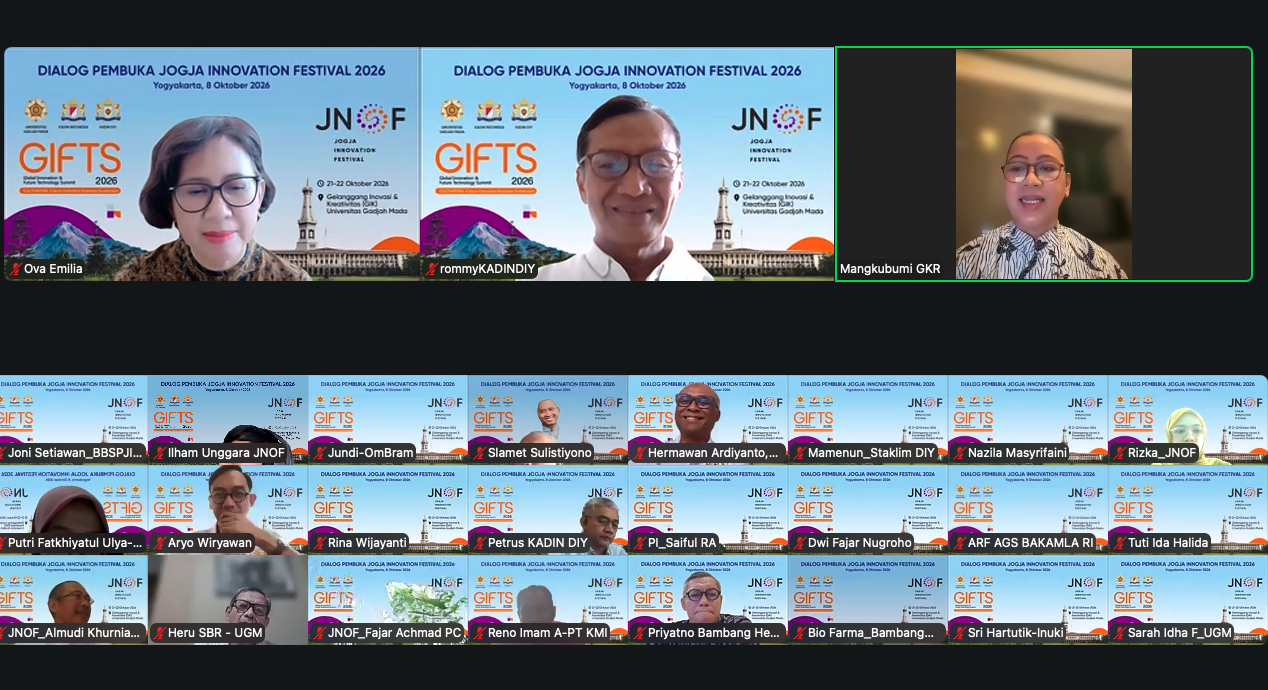
YOGYAKARTA — The Special Region of Yogyakarta Chamber of Commerce and Industry (KADIN DIY), together with the Global Innovation and Future Technology Summit (GIFTS) of Universitas Gadjah Mada (UGM), held the Dialog Pembuka Jogja Innovation Festival (JNOF) 2026 on Thursday, 8 October 2026, from 09.00 to 11.45 WIB via Zoom. Running under the theme “Connecting University Innovation with Industry Needs,” the pre-event brought together inventors and prospective investors to discuss research outcomes, industry requirements, and collaboration opportunities ahead of the main JNOF 2026 festival.
The session opened with remarks from Hermawan Ardiyanto, Chair of the JNOF Steering Committee and Deputy Chair for KADIN DIY’s third division, followed by welcoming addresses from UGM Rector Prof. Ova Emilia, KADIN DIY Chair GKR Mangkubumi, and KADIN Indonesia, represented by Sarman Simanjorang, Deputy Chair for Regional Autonomy. The discussion was then moderated by Aryo Wiryawan, Chair of the JNOF 2026 Organizing Committee and KADIN DIY’s Deputy Chair for Maritime Affairs.
In her remarks, GKR Mangkubumi noted that the partnership between KADIN DIY and UGM dates back to 1987, spanning education, research, community service, and innovation downstreaming, and that a follow-up memorandum of understanding between the two institutions is set to be signed on 21 October. “Yogyakarta does not have vast land or abundant natural resources, but it has a wealth of knowledge and innovation from its universities, including UGM — which makes this agenda a highly strategic one,” she said. She added that KADIN DIY had formed four curator teams — covering the food and agriculture, energy and science, pharmacy and health, and humanities clusters — drawn from KADIN members with direct industry expertise, who screened nearly 180 research outputs down to 100 that advanced to this stage. KADIN DIY, she said, would see the results through to the Business Matchmaking event at UGM’s Gelanggang Inovasi dan Kreativitas (GIK) on 21–22 October 2026.
The curation drew on a base of 177 research entries from UGM’s PRIME STeP program (2023–2026), from which the curator teams selected 57 entries, supplemented by 43 secondary picks, for a combined shortlist of 100 — including 27 flagged as KADIN priority innovations. By originating cluster, the base pool comprised 67 entries from Energy and Science, 52 from Pharmacy and Health, 48 from Food and Agriculture, and 10 from Socio-Humanities.
The 100 shortlisted innovations were distributed across nine discussion rooms spanning three thematic clusters — Food, Agriculture and Humanities; Energy and Science; and Pharmacy and Health — with each room hosting 10 inventors and 10 prospective investors for a total of 90 inventors and 90 investors. Each inventor was given three minutes to introduce themselves, their invention, its unique selling points, and their collaboration needs, with industry participants responding directly with feedback and questions on quality standards, production capacity, and market access.
In her address to researchers and industry participants, Prof. Ova Emilia emphasized that dialogue should start from the problems that need solving, the evidence already available, and the next steps for development, urging inventors to be ready to act on industry input. Several of the curated innovations cited as examples of the program’s scope include the Gamagora 7 seed variety, the Gama EWS 5.0 early-warning system, and a neonatal ventilator.
As the breakout rooms wrapped up, a recurring theme carried back to the main session: competition for inventors heading toward commercialization is intensifying against established industry players, and getting a product to market takes more than good research. Researchers — including several from the medical field, who are not permitted to sell products directly — were encouraged to stay focused on R&D, while a separate, dedicated team carries a product through production and marketing to a commercial launch. Hermawan Ardiyanto closed the session by thanking participants and looking ahead to a reunion on 21–22 October, with final remarks delivered by Petrus Tedjahapsara, KADIN DIY’s Deputy Chair for Industry and Downstreaming.
That division of labor — inventors focused on research, dedicated teams on commercialization — is what the Business Matchmaking at GIK UGM on 21–22 October is designed to formalize. KADIN DIY is targeting the signing of 30 memoranda of understanding between inventors and industry partners at the event, carrying forward the initial matches and unresolved needs identified during the 8 October dialogue. The organizing committee said it will continue tracking each pairing after the MoUs are signed, following innovations through production and marketing toward commercial viability, and will hold further upstream-downstream dialogues on a regular basis to keep that pipeline moving.